Friday, June 11, 2010

Green Soup, Waffles and French Fries: My Belgian Years

We were posted to 1 Fighter Wing, Marville, France with the RCAF in 1961.  The old town of Marville is located on a hill not far from Longuyon, in the northeastern province of Lorraine.  The base was a few miles west of Marville and about 20 kilometers from the Belgian border.  The majority of Canadians lived in huge apartment complexes in Longuyon.  We wanted to live "on the economy" as we called it.  Like many others, we wanted to live in Belgium, as it was a bit ahead of northern France at that time in housing and general living style.

The picture at right is of the entrance to the base, RCAF Marville.

Note:  Nearly all the pictures--not including the food-- were taken in the 1960s and one from 1985 via slides.  I had them developed as photographs and then took the pictures of the photographs with my digital camera.  I also took pictures of other photographs I had.  Many are in black and white (some of them postcards).  Click on any picture to enlarge it and to clarify it.  Just click on the arrow at the top of the page to return to the blog.


Below is a view of the Canadian PMQs (married quarters) in Longuyon, France in the 1960s.

We found a small, furnished second-floor apartment within a family home in Virton, Belgium, about 26 kilometers north of the base (about six kilometers north of the French/Belgian border) in the famous Ardennes Forest region.  We had only two large rooms and they included a combination living room/dining room/kitchen and one bedroom.  The modern bathroom was down the hall.  In the warm seasons, the children slept in a small curtained alcove outside the living room area; in winter, they had their beds in our room.

Our kitchen held a sink (no hot water, just cold) and a wood and coal stove, on which we not only heated our water but did all the cooking.  The oven was just large enough for a turkey at Christmas.  Others we knew had to take theirs to the bakery or butcher shop to be roasted, which was common then.  We shared a fridge with our landlords, the Adams.  It was new.  I  remember seeing only milk, butter and meat in it belonging to them.  They were not used to fridges yet.

To do the laundry, I walked through Madame's kitchen in the rear of the house to an unheated stone room; lovely in summer, cold in winter.  The washing machine was electric but the water was heated by gas.  To start the process, I first had to light a wick underneath the machine to light the gas to heat the water.  None of these inconveniences bothered me in the least.  I was thrilled to be in Europe and I was young, so I did not mind any of the less-than-perfect amenities.
 The picture below shows a view of the town of Virton

 The Adams treated us wonderfully, sharing their culture and special holidays--such as Christmas and Easter--with us.  They also shared their food on many occasions and one of the dishes Madame served was "la soupe verte," a specialty in that particular region.  All the Canadians we knew learned about that green soup from their Belgian landlords.  Madame Adam had it simmering on the back of her coal and wood stove every single day, and every evening meal began with it.  The aroma from that soup wafting into the hallway was welcoming indeed as we climbed the stairs to our apartment at the end of a day.

They invited us to supper one night, and that is when we were introduced to the soup.  I have never seen a recipe for it and have never seen the soup anywhere else but there.  It was darkish green in colour and thick.  With it she served a hearty bread from the bakery just off the market square.  We began buying our own bread there as well.

Below is the narrow cobble-stoned street off the market square.  The bakery was on the left side, almost across from the car in the picture.

Madame told me exactly how she made her soup.  At the time, I didn't write it down.  I did that a few years later.  I made it many times over the years and it came pretty close to Mme Adam's.  I changed the way of doing it a little, but it is still much as she made it. 

Last week I made Madame's soup and enjoyed it almost as much--along with a good bread.  I was unable, of course, to buy the Belgian bread to accompany it.  I did the next best thing and bought the best bread in the world from Herr Burger, the baker in Biederbach, where we go nearly every second Saturday afternoon for a visit.  See it below.


Below, my just-cooked green soup, Herr Burger's sliced bread (perfect with it), butter and a glass of wine.


Here is Madame's recipe for green soup:

La Soupe Verte (Belgian Green Soup) a la Madame Adam

2 bunches of leeks (4 per bunch, with an outer leaf or so removed); 1 whole head of celery, with leaves; 1 onion, peeled and sliced; about 6 tablespoons butter; 1-ounce piece of salt pork or smoked bacon fat; 8 to 10 cups good-quality chicken stock; 1 bunch of parsley, with stems removed and discarded; 4 to 5 medium potatoes (7 small), peeled and quartered; salt and pepper to taste. Optional:  A sprinkle of Fondor or similar seasoning and some splashes of Maggi.  Toppings or Additions:  Creme fraiche or whipping cream.

Slice into half-inch (1 cm) rings the white part of the leeks and the green part immediately after the white.  (The remaining green portion can be used for something else.)  Wash again thoroughly.  Wash the celery and leaves; remove the leaves and set aside; cut the celery into half-inch (1 cm) pieces.

Melt the butter and salt pork in a large soup pot.  Add the leeks, celery pieces and sliced onion and saute them, uncovered, in the melted fat until soft and aromatic, about 20 to 25 minutes.  Meanwhile, chop the celery leaves somewhat and chop the parsley coarsely.  When the vegetables are soft, add the chicken stock, stirring it well.  Add celery leaves and parsley.  Bring to a boil over medium to high heat; then reduce heat and simmer, covered, for one and a half to two hours, until everything is tender and the stock is full of flavour, adding the potatoes about 30 to 40 minutes before the soup is ready.  Partially cool.

When cool enough, strain it through a sieve, as Mme Adam did, or blend it, as I now do.  Because this soup should be fairly thick, I blend the entire amount, doing it in stages so as not to overflow the blender.  Pour it into a large pot, heat it again and season to taste with salt and pepper.  I add some Fondor and a little Maggi.  If wished, you can stir in some fresh cream or creme fraiche before ladling it into soup bowls, although Mme Adam did not do that.  You can instead add a dollop of creme fraiche or whipped cream to the soup bowl before serving.  Add a sprig of parsley for contrast.  This soup, along with hearty bread, is a meal in itself.  Great on a cold winter night--or even on a spring evening.

The soup just poured into the bowl with whipped cream melting on top.

 
The Adams also initiated us into the world of red wine.  Up until then I had found all wine either sour or too sharp.  We were introduced to a wine that changed all of that.  It was one Monsieur Adam brought up from his wine cellar.  That cellar must have had hundreds of bottles, all on their sides in individual little caves in the stone wall.  I have forgotten the year of the wine but it was at least ten years old at that time, so it must have been from the early 1950s, perhaps even the late 1940s.  It was a red Burgundy from the Cote de Nuits, a Chambolle Musigny.  That wine was so smooth with no sharpness at all--just a lovely taste on the tongue and palate.  I learned then that one should be initiated with a good wine, not a mediocre one.

During our last two and a half years in Belgium, we lived in Lamorteau, the border town, as we needed more room for the children.  We didn't lose contact with the Adams, though, and visited often and later kept in touch for many years.

In our new place, we had a fully furnished apartment with our own washer, gas stove and fridge.  Good friends lived in the apartment below.  Our landlords, the Toussaints, lived in the house next door, all of it (including ours and the barn), one-connected building, as is often the case in Europe.  This had been a chateau at one time, though more a country manor house from its style.

A view of  Monsieur and Madame Toussaints's house (ours is to the left and hidden) with the small river passing beside it.  We were told that Marie Antoinnette had stayed here overnight enroute to or from France.

During our time it was a working farm with cattle, geese, ducks and chickens, so our children were introduced to these animals daily, including brand new calves and chicks and ducklings.

Our house faced the side of the stone church that bordered the farmyard.  Just around the corner was a small bridge crossing a narrow river, with a bakery and a hair salon on the other side of it and a grocery store just beyond them.  By this time our two children were speaking French and often went to the store or bakery for us.  No worries back then for children out playing.


To the right is a postcard showing the stone church. Our house is just to the right of  the white building and facing the church.


A winter scene in 1963.  The bakery and hair dresser are both on the corner with the river flowing beneath the road (bridge).  The church and our house are just out of sight on the right side.


Lamorteau was a small village and years later, when Hans and I returned on a visit, it hadn't changed other than all the cattle dunghills were no longer in sight.  In this part of Belgium and all over northern France that is where you found them--outside the barns, almost next to their front doors.  The backyard is where their gardens were.  Today, things have changed in both Belgium and France.  Driving through the area on that visit in 1985 and again a few years later, it was quite amazing and pleasing to see flower gardens and grass instead along the streets.  For many years now communities all over France have been vying  for the stars given each year for especially lovely flowers and gardens in the villages, towns and cities.  The signposts on entering a community show how many--if any--stars they've received.  As this can be a draw for tourists, it does encourage towns to participate.

The picture below, taken in 1985, shows our house, the one with the red geraniums in the windows.  Just to the left was our garage.  To the right, is the Toussaint's house.  Across from our house, is the side of the church.


One of the things Madame Toussaint made was "gaufrettes" or waffles.  She would cook them in her waffle iron, open her kitchen window outwards and call the children.  She would then lean out to give each a warm waffle, sprinkled with icing sugar.  That was a real treat and all of them loved them.

Years later, in the early 1990s, I attended the Dijon Food Fair in Burgundy with a friend.  One of the booths at the fair was making waffles, triggering that Lamorteau memory.  Lillian and I had one each.  First, hot from the waffle iron, the baker spread them with a rich chocolate sauce and then slathered them with whipped cream.  Oh, how delicious they were!  It brought back those years in Belgium and those other hot waffles, simpler and made by a farm woman in her kitchen--but no less memorable.


This week I decided to make them myself.  The picture at right shows a waffle topped with Canadian maple syrup (Ahorn-Sirup in German) which I bought at a supermarket here.  That is a product that wasn't seen in Germany that long ago.


 Below are two small dessert waffles.  I covered them with chocolate sauce, whipped cream and a drizzle of extra chocolate on top and added four strawberries to each.  These were rich, sweet and delicious.  Almost as good as the one in Dijon. 


One of the most famous foods in the world is French fries--or pommes frites as they are called in Belgium and France.  In Germany they are as well, but often they are just called "Pommes" (pronounced pom ess).  Belgium is renowned for their frites.  When we first moved to Belgium in 1961, we soon found out how good they were.  Not, of course, good for you, but oh-so-good to eat!  It was common to take a large empty bowl to the cafe in downtown Virton (only a two-or three-minute car drive from our house) and ask them to fill it with pommes frites to take home for supper.  They were crisp and delicious.  They cost about the equivalent of 25 to 50 Canadian cents for a full bowl, with more than enough for four.

Below, a bowl of freshly made French fries or pommes frites that I made for supper last evening.

Friends Chris and Filiep, along with their two sons and Filiep's mother, Jenny Vercruysse, drove down to our area to celebrate New Year's Eve about three years ago.  Chris and Filiep lived near Ramstein, Germany and Jenny near Bruges in Belgium.

Over dinner at a Gasthaus the next evening, we discussed pommes frites at length.  Jenny was born and raised in Belgium and told us there is a trick to making good ones.  This is how she makes "frites maison" (home-style French fries):


Belgian-Style French Fries a la Jenny Vercruysse

Cut peeled potatoes into strips.  Soak them in ice-cold water (I add ice cubes to the water) until the starch has been removed from them (draining the water and replacing it with more ice cold water) for 30 minutes to an hour.  Remove them from the water and dry them well.  That is important.  Set them on paper towels.

First frying:  Deep fry them in batches in hot peanut oil, at 340F (170C), for 2 to 4 minutes, depending on the size of the chips and the type of potatoes used.  They should be soft to the touch but still white, not browned at all.  Drain them well and allow them to cool.

Second frying:  Before serving them, deep fry them again in the oil at 350F to 375F (180C to 190C) until golden.  Note:  Jenny says that peanut oil is important and the temperature is important for both fryings.

Our landlady in Belgium also used peanut oil, though I never asked her how she made her pommes frites.  I just ate and enjoyed them, recognizing that they were special.  When you want French fries on the spur of the moment, this method would be too time-consuming; if you plan ahead, though, you can have the potatoes ready a few hours earlier--except for the frying. 

My supper last evening:  Jenny's pommes frites, fresh tomatoes, and German marinated ribs with a North American, freshly made barbecue sauce.   One of my favourite meals!


Bon Appetit! 


Friday, May 21, 2010

Beer and Its Brewing Process--Part Two

We arrived at the Löwenbrauerei at 9 o'clock in the morning.  We had arranged with Johannes Dold, the owner and brew master, to have a tour of his brewery.  By then, the brewing had been in process for about three hours.  Herr Dold met us and spent the next hour showing us and explaining to us how they brew their beer and about some of the complicated machinery they use.

Johannes and Luzia Dold

This is an old family brewery, dating back to 1856.  The picture below right is from an early era, with the brewery Gasthaus on the upper, right side of the picture.


As mentioned in my last post, this brewery has remained in the same family for all 154 years and has won many prizes for their various beers over many of those years.  I will briefly explain the brewing method and though it may sound relatively simple, in fact it takes a lot of expertise and experience.

Brewing Process

1.  The beer brewing process begins in the brewing kettle, where barley malt is combined with water.  It is then heated to various temperature stages in order to break down the starch enzymes.

The brewing kettle

 Below, right, it shows the brewing  inside the kettle.  It will remain here for about four hours.


Herr Dold and Hans discussing the brewing stages


2.  After that process is completed, hops is added; in the case of the Löwenbrauerei, the traditional female hop cones are still added by hand in the proper proportions for different types of beer.  (Herr Dold does not use hop pellets, which are more commonly used in larger commercial breweries.)  It is then boiled for a specific time frame determined by the brew master.


Pictures of hops(decoration) hanging from the ceiling inside the retail store.


3.  After the brew master determines it is ready (it can take up to eight hours), the liquid is separated from the solids and cooled off.  That liquid is then transferred to large primary fermentation vats or vessels where the yeast is added, yeast being specific to two primary yeast types:  aerobic for top fermenting beers, such as ales and wheat beer; anaerobic for bottom fermenting beers, such as Pils and Export (in English, those are referred to as lager beers).

A picture of the primary fermenting vat, showing 4,050 liters of Export (lager beer)


 4.  After primary fermentation is completed (normally seven to eight days), the beer is then transferred into large--now generally stainless steel--tanks for the final fermentation process for a period of six to eight weeks.  This takes place at a very low temperature, about 2 Grad.  Aging at this low temperature allows the carbon dioxide to combine with the beer.   In the Elzacher Löwenbrauerei, as in most small breweries in Germany, natural carbonation takes place in the above fermenting process.  Excess carbon dioxide is released to the ambient air through pressure valves.

 Below, pictures of the final fermenting lager vats


5.  After the maturing process is completed, the brew master will then filter the beer.  Pasteurization as practiced in North America is normally not done in Germany as the pasteurizing process removes much of the typical beer flavour and aroma.

6.  After filtration, beer is then bottled or put into kegs as required.

Below, the cases of bottles on the right; the kegs shown are now used for special occasions, such as festivals. The modern stainless steel "keg" type is now utilized.


.


This is a simplified version of a complex beer brewing process, which starts with the malting of the brewing barley.

Below, a glass filled with barley, along with one of  the Löwenbrauerei's various types of beer glasses


The Elzacher Löwenbrauerei's Weizen (wheat) beer is still done in the traditional final bottle fermentation process very much like home brewing.

A case of Weizen beer is shown below in the fermenting stage in the bottles.  Note the guage at the back


Germany is rightfully proud of still adhering (by law) to the oldest food regulation in the world.  That is the Reinheitsgebot (purity law), which was passed by Herzog (Count) William IV in 1516 in Bayern (Bavaria).  The reason the count passed this law was that he was thoroughly fed up with drinking the often abominable brew that was offered to the nobility but also to the general public at that time.  The fine for brewers who did not adhere to the new law was that they had to drink 10 liters of their own beer (or swill!) in one sitting! A punishment that brought the point home!

The Reinheitsgebot law stipulates that beer can only be made from three ingredients:  water, barley malt and hops.  Yeast, of course, must be used to start fermentation.  As that had not been discovered at that time (1516), the fermentation process then had to depend on natural wild yeast which is found in ambient air.


In later years, wheat malt was also permitted but never any rice or cereal grain malt as frequently used in North America.  Also, the common usage of invert sugar in North America is verboten (forbidden) in Germany.  Herr Dold's hops come mostly  from Bavaria and his malt from Lahr.  As a matter of fact, the Lahr malt plant is one of the few in Baden-Württemberg.  For those of you who are familiar with Lahr, the malt is produced in the large brick building near the Bahnhof (train station). 

Beer tastes differently from brewery to brewery primarily due to using different malt or hops or water, as well as using different amounts of each from one brewery to another.  Needless to say, all breweries protect their recipes.

A Gasthaus usually carries the beers of only one brewery, which means that if you are a beer drinker, you will probably check for the beer sign outside the Gasthaus in order to see if it's a beer you like--or perhaps if it's one you have never tasted and wish to try.  When we are in an area of Germany not our own, Hans does just that.  Small private breweries don't ship outside their own area, and it's a chance to try another beer:  a new taste and a new experience as a beer drinker!

At left,  a rare pre-second- world-war brewery Gasthaus sign seen in our immediate area at the Gasthaus Waldlust.


The picture on the right does not show the name of the Gasthaus Pflug, but it does show the Elzacher Löwenbräu that it serves inside.


 The picture directly below is painted on the side of the Brauereigästätte in Elzach (Brewery Gasthaus)


The plaque below is attached to the side of that same Gasthaus.


A perfect Pils!  Prosit!


Both Hans and I took the pictures in my two blog posts on beer.  As well, all of the expertise is from Hans and from Herr Dold, both of whom I thank.


Tuesday, May 18, 2010

Beer and Its Many Aspects--Part One


A well-presented beer!

I am not a beer drinker.  Hans, though, is a beer connoisseur and knows much about it and the industry.  He is my expert today.  Hans has been drinking that frothy beverage for years, but he also took a correspondence course in beer brewing for a while many years ago, read beer magazines over the years and anything else relating to it as he still does today--plus talking to anyone who makes, sells or serves beer!

Since I have known him, he changed from "only-a-beer" drinker to a wine drinker and connoisseur (particularly Bordeaux wines), making himself smart on that subject, too.  I'll use that expertise at a later time when I write about wine.  Today, though, it is all about a beverage that many love throughout the year and especially on a hot summer's day.

Below, Hans' brother-in-law, Günter, "prosting" with Hans (unseen except for the tip of his beer glass). 

The picture below right is of Hans in Sasbach under a chestnut tree just coming into leaf, at a beer garden beside the Rhine, with France just across the river.  Many beer gardens and Gasthäuser offer fresh pretzels, which go perfectly with beer.


The picture at left is of Hans in another beer garden in the countryside.  This was on a Sunday afternoon and the place was busy.  There were tables and people everywhere, but this was a quiet spot.


In the 1980s and early 1990s, Hans bought his kegs of beer from Kälble Braurerei in Steinach.  When Kälble closed down their brewery--selling all their equipment, including copper brewing kettles, to someone in California--Hans began the search for another small brewery that would come up to the same standard.  That is when he discovered the Löwenbrauerei in Elzach.

The picture at left shows the area in front of the Löwenbrauerei with cases of bottles filled with beer to be delivered to some of  its customers.  You can see the copper brewing kettle inside with one of the brew masters working beside it. 

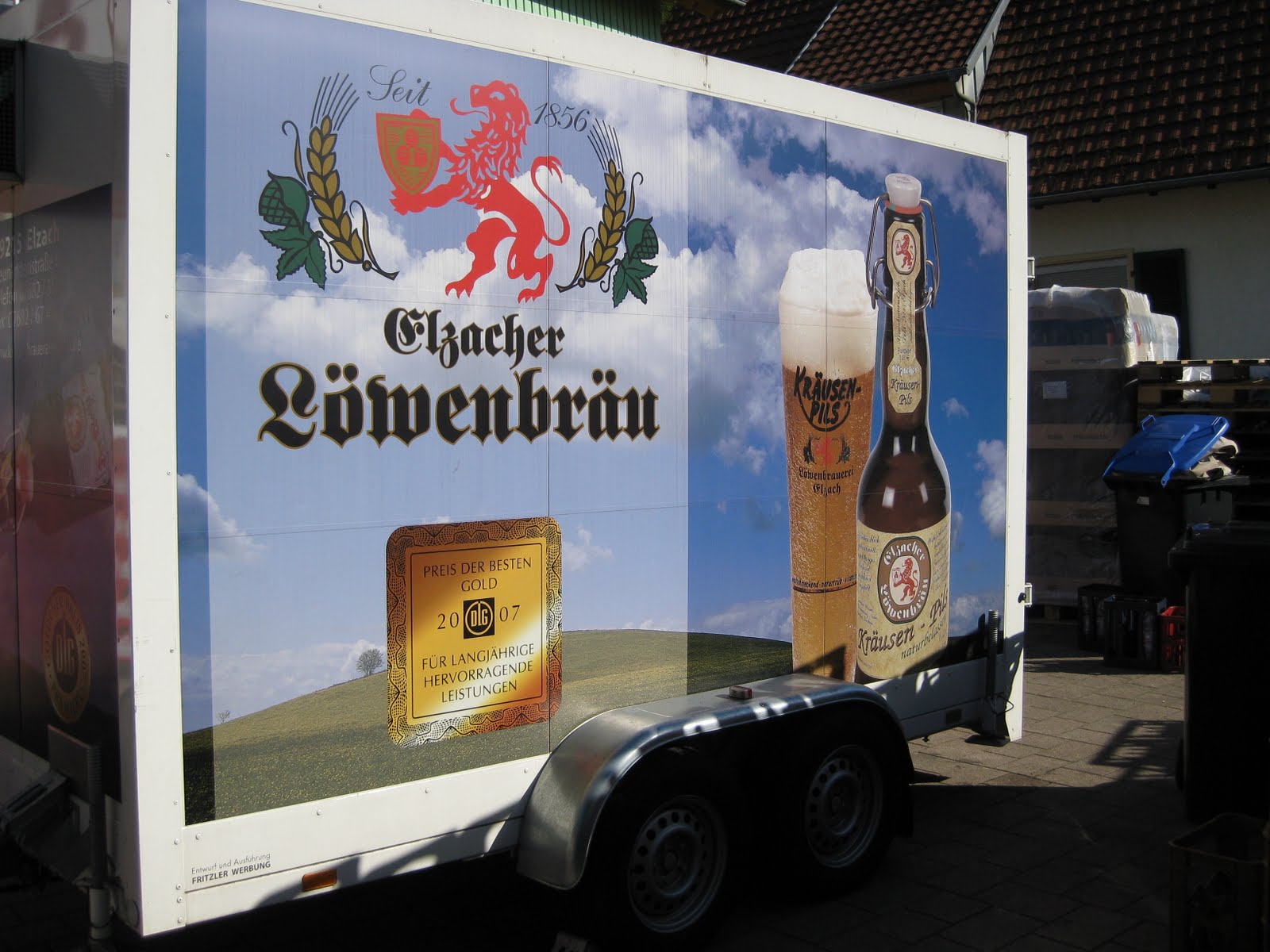
Hans has been buying his Pilsener-type beer at the Elzacher Löwenbrauerei for the last 15 years and swears it is the best Pils in the world!  Many agree with him.  Johannes Dold, the owner and brew master, has won gold medals in Germany every year for his various beers including this year:  2010.  He won the "best-of-the-best" in Germany in 2007 and many other awards since. The "best-of-best" goes to a brewery that has won 2 awards for their beer every year for 15 years.  A special prize indeed!  This is a small, private, family-run brewery, which means that it was a huge honour to receive such a prestigious dedicated award.


Some of  the Löwenbrauerei's awards shown on the wall inside their retail store.


Shown below is a brewery advertisement showing the gold medal won for best-of-the-best in 2007


The brewery celebrated its 150-year anniversary four years ago:  1856 - 2006.  Johannes Dold took it over from his father in 1995.  It has been in the same family for those 154 years.  That's not such an easy undertaking these days in the beer business as large brewing monopolies are usually waiting to take over these small breweries.  In fact, this is a negative development occurring in Germany and many other countries, including Canada and the United States.

Johannes and Luzia Dold (with Hans' hand talking!)


Approximately two decades ago there were far more breweries in our region than at present.  This holds true for all areas of Germany; however, the province of Bayern (Bavaria) still far exceeds the number of small breweries than anywhere else in the country.

We hope that Herr Dold's brewery will remain as a family enterprise, as hundreds of private breweries have closed or been taken over in the past number of years.  Herr Dold's wife, Luzia, looks after the administrative side.  His daughter is now studying the brewing business.  That is a positive side to their craft and will hopefully lend continuity to the family brewing heritage.


The sign at right is on the Brauereigaststätte (Brewery Gasthaus) in Elzach.  It is owned by Herr Dold of the Löwenbrauerei.  Most Gasthäuser show the name of the beer they carry on the Gasthaus name sign.


Elzach, where the brewery is located, about a 35-minute drive southeast of us, is a typical Black Forest town.  Several Gasthäuser and shops line the narrow and picturesque main street.  Fifteen minutes north of Elzach is the village of Biederbach and the Gasthaus Deutscher Hof, where we go frequently.  Herr Burger, the Wirt (inn keeper), for years had only Riegeler beer on tap.  He now also has Löwenbräu (mainly because of Hans, I should add!).

Another Gasthaus we know in Freiamt also now carries Löwenbräu and their customers are ordering more of Herr Dold's beer than the original beer they had been carrying.  The Elzacher Löwenbrauerei also supplies its beer to several other Gasthäuser in the area.  Herr Dold has a few employees working for him, including another brew master.  He also has a retail store directly beside the brewery where one can buy his various beers, by the keg or bottles, including numerous soft drink products.

The retail store beside the brewery, with me standing near the car


The picture at left shows signs with the cost for various cases of beer (20 half-liter bottles to a case, which equates to 71 Euro cents a bottle at Euro 14.20 a case--the most expensive beer offered; that's about 56 Canadian cents per 1/2 liter bottle--depending on the currency fluctuation rate).


We have a small beer fridge that will hold a 15-liter keg of beer.  Hans prefers Pils which he has on tap at home.  The story of his fridge goes back to 1980.  A friend of his, Ernst, who owned a Getränkemarkt (a store that sells all types of drinks:  beer, wine, Schnaps, soft drinks, mineral water), found the fridge on the side of the road on household bulk refuse day.  He picked it up and took it home, then called Hans to see if he was interested in it.  Hans was.  It cost him nothing.

The fridge was from the 1950s and didn't work.  A German acquaintance of Hans at the Canadian Forces Base in Lahr offered to fix it for him, which he did for a small token (a gift of a bottle of Canadian whisky!).  Hans then installed a beer tap and associated carbon monoxide delivery system, covered it with a solid piece of varnished wood and painted the fridge a more appropriate colour.  That same fridge is still going strong today, 30 years later, with a keg of Elzacher Löwenbräu Pils in it--as it usually has!

Below, pictures of the outside and inside of the fridge with the keg hooked up (and a bottle of Weissherbst beside the keg, my favourite wine!) Note the Elzacher Löwenbräu sign on top.


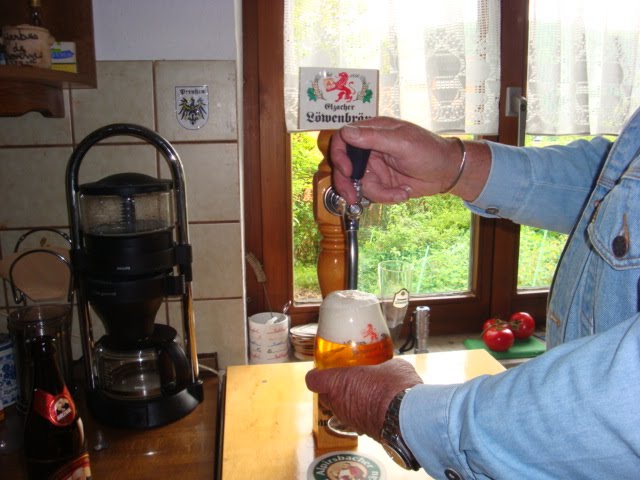
The three pictures below show Hans pouring a glass of Pils.  A Pils is topped up slowly, so that in the end a good "head" almost overflows the glass.  You press the tap once and then not again until the foam settles down.  Then you tap it again.  You do this until the beer is at the proper height in the glass and the frothy head is well above the rim of the glass.

                                                                           
The picture below, on the left, shows the foam after pressing the tap; the picture on the right shows the Pils to be nearly ready, with the foam or head now slightly above the rim.


Beer is a matter of taste, which means each person has his or her favourite type and brand of beer.  Pils is made with more hops and less malt than Export, thus it is slightly more bitter.  Hans says that when he first moved down to Lahr from northern Germany with the Canadian Forces in 1970, nearly everyone in this area drank Export.  It is still the most popular beer here.  Pils was not common in this area, though it was the most common type of beer in northern Germany.  Now, of course, nearly all Gasthäuser and restaurants serve all three:  Export, Pilsener and Weizen (wheat) beers.  The Elzacher Bräuererei brews all three, plus a Jubilium's beer in winter. They also brew a Kräusen Pils which is an unfiltered beer with a unique and very pleasant flavour.

Pils (a lager beer) takes its name from Pilsener, which was first brewed in Pilsen (Plzen), Bohemia (now the Czech Republic) in the 1800s.  That is what Hans will usually have when at a Gasthaus and nearly always at home.  One exception to that:  when he is very thirsty and wants a quick beer, he orders an Export (also a lager beer but with less hop flavour).  A glass of Pils is topped up slowly and the old saying is that you wait seven minutes for it to be ready.  On a hot day, that seems like a long time for someone waiting to quench his or her thirst!  Hans, of course, when he orders an Export, also orders a  Pils at the same time--to have seven minutes later!
What can be better on a warm, sunny day for a beer drinker than such a Pils as shown below, ready for the first taste!

Zum Wohl!  Prosit!  Cheers!


A note:  I will be posting "Part Two" on beer in the next couple of days.  That will be about the brewing process itself and the ingredients used in Germany, with pictures from inside the brewery and the retail store. 

A reminder:  To see the pictures in a larger format, with more clarity, just click on the one you wish to look at.  Click on the arrow on the top left corner to return to the blog.