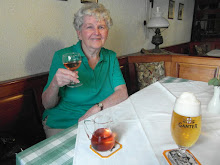
Beer around the world

We had no idea what to expect as this was the first time we had been to a Bier Probe--or as we say in English, a beer tasting. It was held at the Gasthaus Rebstock in Münchweier, just a kilometer from home. The Fürstenberg brewery, located in Donaueschingen, offered the Probe: the beer, the sommelier and the tasting. The butcher shop belonging to the Gasthaus supplied the various sausages and Schinken. Fürstenberg Bier has been brewed since 1283. King Rudolf von Hapsburg handed the rural county, where Donaueschingen lies, to Count Heinrich von Fürstenberg. One of the feudal privileges was the right to brew beer. That can be seen in the original manuscript which lies in the Fürstenberg archives. By the end of the 18th century, beer production reached 1.65 million liters. The Fürstenberg brewery was a purveyor to Kaiser Willhelm ll. In 1972 it was the first brewery to be awarded the designation of "Premium-Bier." (The foregoing information was from www.fuerstenberg.de)
 We had toured several breweries and had tried a sample of their various beers offered (or Hans had, I should say), but we had never had a Probe at a Gasthaus. We had been lucky to get a reservation for six just a couple of days beforehand. As Hans had organized a number of outings at the Gasthaus, he was known. That helped.
A bowl of hops for decoration
We arrived at the Rebstock at 6:30 p.m. and weren't on our way home until 11:30 p.m. So a long evening that flew by. And what fun we had!

I shall now say that I had never drunk even one glass of beer in my life as I am not a beer drinker. I love my wine; in particular, Weissherbst, as I've mentioned many times here. I debated the pros and cons and decided that if I was going to a beer tasting, then I would taste the beer. At least a sip or two. As many did not get reservations, I thought that was the least I could do. I also thought that the men might help me out! Little did I realize just how much beer would be served, meaning no one would be looking for mine. (A lady at our table did drink wine after the cocktail, but her husband got it from the bar as no wine was served at the tables that night.)
Hans loves beer and knows a lot about it. Of course, he also learned everything he could about beer by taking a year's correspondence course in beer brewing. When I first met him, that is all he drank, and I swear he knew about every brewery in all of Germany! And about all their beers, too. (He was even up on beers beyond Germany.) Those were the days when we would go into a Gasthaus that had a beer sign indicating a beer he had never had. He wanted to try it. Even then, I did not capitulate. I stayed with wine. This all means that I shall be calling on his expertise before I finish this, rest assured.
The table across from ours, with the evening underway

The evening began with the Ettenheimmünster band--all dressed in their Trachten band uniforms--getting everyone into the perfect mood: the type of music that got the crowd clapping and swaying. With arms linked, we all sang along to the uplifting marches and Fasching-type songs, ones that nearly everyone knew. The large party room was filled with more than 120 people. One of the waitresses also played in the band that night and in-between times served beer and platters of sausages and Schinken.
The elderly couple from the Alsace whom we met for the first time. They had a wonderful evening.

Beer Cocktails


The evening started with a beer cocktail. We certainly hadn't expected that. To my surprise, it was quite refreshing and fairly light in taste. I had never had one and neither had Hans in this part of the world as that is not something a Gasthaus ever serves. But it was good! It's not that I loved the beer taste, but it was mild and pleasant. Hans wasn't as keen as he is a "true blue" beer connoisseur. I'm not sure how it was made, but it got things rolling.

A little aside: After saying all of that, we did have beer cocktails several years ago: the renowned Berlinerweisse. That, of course, is a specialty of Berlin. I had tried that for the first time when on a trip to West Berlin in the mid 1970s. Later, in the 1990s, Hans and I ordered it several times in the Schorfheide, the area in which he had grown up. I wrote a little about it in my blog post of March 1, 2011. (That post was part of a series of four about the former Eastern Germany.) The picture shown is of the two of us, Hans' son, Heiko, and his wife, Heather, at a small Gasthaus in the Schorfheide.
Berlinerweisse is made from a top-fermenting wheat beer that is mixed with either raspberry syrup and tastes a little like Champagne and is red in colour, or it can be made from Waldmeister/waldruf and tastes a little like cream soda and is green in colour. They are always served in a large-bowled stemmed glass with a straw (as shown in the picture above).
The table below was especially set up for the evening by the brewery and Gasthaus. Wooden boards are traditionally served for Wurst along with a sharp knife.

The Fürstenberg brewery is a large one. Their sommelier (yes, he called himself that) began by explaining the first beer and also some of the history, as he did for all the following beer types. Fürstenberg bought out the Riegel brewery a few years ago. That brewery was situated about 30 minutes south of us on the outskirts of the town of Riegel. The entire brewery and buildings were closed and the operation moved to Donaueschingen. (They did retain the historic part of the brewery, easily seen from the road and Autobahn when passing by.) Fürstenberg brewery continued to brew Riegeler beer and retained its name. They still sell it as Riegeler beer. They say it is the same recipe as always. Perhaps the recipe remains the same, but do the ingredients remain exactly the same? Do they use the same hops or barley for example? Hans says the beer does not taste as it once did, so perhaps the quality of the ingredients is different. We cannot say that is so however. The water itself is also a big part of beer and that would also change the taste. Not everyone thinks it tastes differently, but Hans does. That is not to say he dislikes it, though.
Since then, Fürstenberg itself has been sold to one of the largest beer conglomerates in the world. Its brewery and buildings, however, were not closed down and their operation continues in Donaueschingen, brewing their same beer as well as Riegeler beer. Conglomerates have been buying up one brewery after another around the world. Not a good trend. They always say the beer is the same as it was, but we still ask, "Is it?"
After most guests had finished their cocktails, the first beer arrived for tasting. I drank about three- quarters of mine as it was not too strong. I didn't particularly like it but I didn't particularly dislike it either. I was actually a bit surprised about that.
The first beer at our table after the cocktail.

Prosit!

1st beer: This was an Edel Export. An Export is less bitter than a Pils. An Export glass is almost the shape of a water glass or it can be served in a glass with a handle.
Each beer that was served came in the proper glass for that particular type of beer. That is standard at every German Gasthaus: whichever beer they carry, the correct glass holds the correct beer. The glasses are provided to the establishments by the brewery.
2nd and 3rd beers: A Riegeler Pils came first; a Fürstenberger Pils came shortly thereafter. A Pils is served in a glass with a stem and is tulip shaped or slim. It is never served in a glass with a handle.

 The two Pils. The young waitress at right was also part of the band. She worked for a year in New Zealand so likes practising her English.
A Fürstenberg Pils

By this time, everyone was ready for something to eat. Wurst is almost synonymous with beer. You have one; you have the other. Many Gasthäuser have Pretzels--also synonymous--on the bar or Stammtisch for guests to have with their beer. You do pay for any of them, of course. On this night, all were included in the price of the evening: Euro 14 per person.


1st platter of Wurst: Various types of Wurst on the platter and a basket of bread. The bread was served throughout the evening. For 16 people at a table, three to four large platters were served for each Wurst served throughout the evening.
The waiters and waitresses were efficient, friendly and fast and certainly earned their wages that night with all the serving and carrying of heavy trays. Any leftover filled glasses of beer were offered to anyone who wished another.
4th beer: Weizen Bier, a wheat beer.

Hans is not a fan of wheat beer as it is not a "real" beer according to him. Beer should be made with only barley, hops, water and yeast, the latter used to start fermentation. Anything else is not allowed according to the 1516 German (actually Bavarian) Reinheitsgebot (purity law), passed by Count William IV of Bavaria. This is the oldest food law in the world. Wheat malt is allowed, however, but never rice or cereal grain malt.
The next platter (or bowl) of Wurst arrived with the Weizen Bier. That included the well-known Bavarian or Munich sausages with sweet mustard and Pretzels.
2nd type of Wurst:

 The white sausages always are served from a large bowl of hot water.
The bowl is partly shown behind the Weizen Bier glass.

 Sweet mustard and Pretzels are always served with Bavarian style sausages.
Weizen Bier at left; Dunkel Bier on the right

5th Beer: This was a Dunkel Beer, which is a dark beer. This one I did not try.
The waiter offering glasses of Dunkel Bier; our friend Gilbert in the forefront.
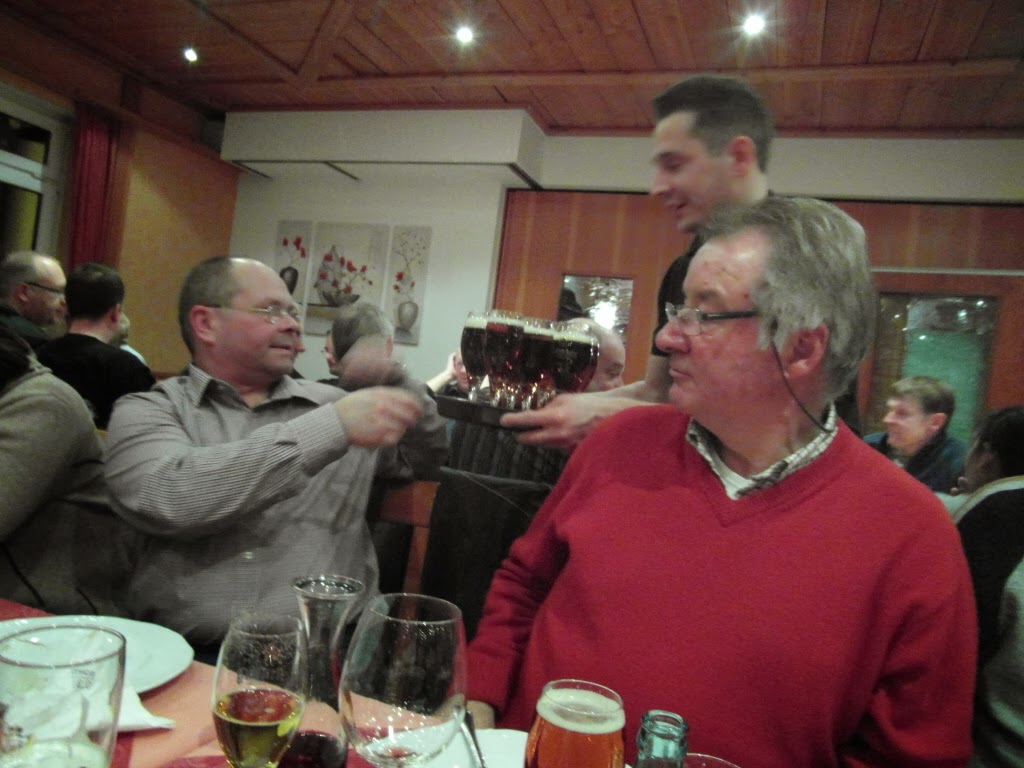
3rd platter of Wurst: With the dark beer, a tray of sausages was served. Rye bread was served as always.


6th and last beer: Bock Bier, a heavy beer with a minimum of 6.5% alcohol. Needless to say, I did not drink any. Hans does enjoy it as do many others. This was served in large, heavy glasses with a handle.
The Wirtin (Innkeeper's wife)

With the Bock Bier, a tray of Schinken was served, all beautifully presented.
4th platter of Wurst:


Towards the end of the evening, a special slicing machine was demonstrated. The last Wurst was sliced as we watched and then served at the tables. Of the last three Wurst served, I perhaps had only one piece from one of them, as I could not eat anything more.
5th and last platter of Wurst

The slicing machine

A line-up of my beers, most not finished and some not drunk. Not sure if anyone drank any of them or not. I just know that I didn't. I did taste them all though. The beer drinkers reading this will wish they had been there!

As the evening progressed, we could barely believe how generous the Gasthaus and the Fürstenberg brewery had been. Euro 14 is less than $20 Canadian (depending on the dollar to Euro exchange of the day). Beer flowed throughout the evening. We had been offered a total of six beers to taste and with more than 120 people, that would have been a minimum of 720 glasses of beer. For each person, it would normally cost at least Euro 14 for the beer alone. It was a wonderful evening with a tremendous atmosphere, traditional German brass band music, Bier, Wurst, friendly and efficient service and, most of all, happy guests. A spectacular night!