Tuesday, November 30, 2010

To Tempt the Appetite: Schnitzels and Other Offerings


A summer day at left in the hills and mountains and first snow as seen from our patio this weekend, on First Advent.


The province of Baden-Württemberg is renowned for its food, its wine and its scenery.  It is the second most visited part of Germany--the capital Berlin being number one.  We can find elegant restaurants and simple Gasthäuser in all directions, some within a few minutes and others within half an hour's drive.  Mostly we look for the simpler places:  family-run, friendly and with "gut bürgerlisches Essen"--meaning non-pretentious, home-style cooking.  From time to time, though, we eat at a fine restaurant where the food is excellent, the menu is large and interesting, the decor and ambience are gemütlich.  Above all, we look for friendly service wherever we go.  We might return to a Gasthaus or restaurant where the food was not exactly as we thought it would be, but rarely will we return to one where the service was unfriendly, seldom though that is.  We do tend to give such a place a second chance, however, as anyone can have a bad day--just not two in a row!

The three pictures below are of Gasthäuser we frequent:  The Waldlust, Lieberatsbergstube and a Vesperstube in Yach, southeast of us, all of them in the countryside.


German housewives are very good cooks and most cook according to their local specialties and the seasonal produce.  Farmers' markets abound.  Many of the supermarkets buy from the local farmers as well.  Many housewives, especially in the towns and villages, have their own gardens, with some produce lasting well into late fall or early winter.  Right now, Feldsalat is in season and available everywhere, including in those gardens.


Feldsalat - Lamb's Lettuce or Field Salad

Sprigs of Feldsalat, the left one right side up, the sprigs on the right, showing the stem side & right side.

The bowl of salad below is without dressing, just with washed and ready leaves awaiting our supper last evening.

This is my favourite of all salads and it is offered at most Gasthäuser and restaurants at this time of year.  It is a green that requires cold weather and will be available until early spring.  The small leaves, tender and mild, form a circle around a stem.  It is usually served with a dressing that is made with mild vinegar, oil, minced onion, fried Speck (bacon cut into dice and fried) and herbs of one's choice (though sometimes no herbs), topped with croutons that are sauteed first in butter and sometimes in garlic.  Below is our salad of last evening, with dressing and croutons.


We had a simple meal along with a bottle of Beaujolais Premier 2010, which was very nice with the Feldsalat.  That wine will last perhaps a year. 

Schnitzels

The picture below is at the Zum Schwert in the hills outside Seelbach, a small town near Lahr.  This was from a year or so ago.  Helga and Wolfgang ordered Schnitzels with Zwiebeln (onions) and I ordered a regular Schnitzel paniert (breaded).  The portions are large as you can see.  Hans's Vesper can be seen at the edge of the picture.

        
Gasthäuser serve mostly local dishes or typical German dishes known around the world, such as Schnitzel in all its many varieties.  Restaurants offer local specialties but also specialties from around the country and the world--though not always Schnitzel.  I am a Schnitzel fan.  Hans complains that I order it too often and don't try some of the other offerings; I do, though usually just not the ones he particularly likes, such as his favourite, a Vesper.  That is a cold meal--usually eaten in the evening, which is served on a wooden board covered by various sausages and Schinken (ham), some raw onion slices, a pickle or two and perhaps a wedge of cheese, all accompanied by a hearty bread.  A good Pils and a Kirschwasser (cherry Schnaps), both served at the same time are the preferred liquid accompaniments (helps the digestion is the excuse for the latter!).

I did have a Vesper this fall at a Vesper Stuben down a long, country road outside Elzach and the village of Yach. Below shows my board in front with a selection of cheese and Wurst.  Hans' board is just beyond.  This was a farm that also offered food, all made or produced right there, except for the cheese.


Vesper is loved by many, but I like a Schnitzel with French fries and a salad, or a Paprika Schnitzel covered in a sauce that consists of red peppers and onions.  Many Canadians who come back for a visit love Jägerschnitzel (Jäger means hunter, so a hunter's Schnitzel).  It is a pork Schnitzel (unbreaded), covered in mushrooms with a mushroom sauce.

Below left, a paprika Schnitzel with French fries.  On the right, a Jägerschnitzel.


In our area, most Schnitzels are made from pork (unless otherwise specified).  They can be breaded or unbreaded ("paniert" or without "paniert").  Pork in Germany is of high quality and rigidly inspected.  

A Wiener Schnitzel is always breaded and always made from veal.  If advertised as Schnitzel Wiener Art, it will be breaded but not necessarily veal.  We prefer the pork Schnitzels as they have more flavour we feel, though a Wiener Schnitzel in Wien (Vienna) is special and a must to have when visiting that beautiful city.

If you visit Germany, you will find that each type of Schnitzel will be somewhat different at each Gasthaus.  They all have their own way of making it, though all will follow the standard method.  Those with toppings or sauces, like Jägerschnitzel, Paprika Schnitzel, Zigeunerschnitzel or Schnitzel with a cream sauce will be different everywhere, as the quality of the meat is a factor, along with each cook or chef who will add his or her own touch to them, especially to the sauces.  Breading can also be somewhat different as an herb may be added (or not) to it before frying.  Below, my meal one evening last spring at the Lieberatsbergstube (picture of that Gasthaus at the very top).  This was a Schnitzel with sauce and Krauter butter (herb butter).


You must drive up the side of the mountain to reach this farm Gasthaus.  Luckily I met no other car on the way up or down, though the Gasthaus outside, where we all were, was packed.  Most had walked up!


I stopped on the way up to take this picture, looking back to the Schutter valley below


Martin, the chef and Wirt (owner) at the Gasthaus Engel in Dörlinbach--as well as being a friend of ours--cooks a special Schnitzel for us, a Zigeunerschnitzel (Hungarian style) paniert, which is covered in mushrooms, green peppers and onions and a delicious sauce.  We had asked him long ago if he would bread it first, rather than preparing it without breading, as is the norm and served that way at the Gasthaus and others.  He agreed.  Many years later, that is the way we still order it.  (In the early 1970s, at a Gasthaus just north of Lahr--now closed--I had breaded Jägerschnitzel, which was unusual, as that Schnitzel is also served without breading, just with the mushroom sauce.  It was delicious.  I never forgot it--nor the huge mushrooms with which they covered the Schnitzel.)

On the left, a platter of Zigeunerschnitzel (4 Schnitzels on it, covered with vegetables and sauce, for two people).  The plate on right shows one helping with some French fries and potato croquettes. When my sister Carol visited us from New Hampshire in the United States, this was her favourite meal.  Ours, too!


Another favourite of mine is Schnitzel with a cream sauce and the very best one I've had is at the Deutscher Hof in Biederbach.  Ruth's is superb, the sauce rich with cream and full of flavour.

One that has stayed in my memory from the mid 1970s was served at the Gasthaus Löwen in Mahlberg, a Gasthaus that is now closed, run then by a lady who was close to 80 years old.  Hers was much like Ruth's is now, with a delicious, creamy sauce.  It was her side-dish of potatoes that brought many customers there as well:  Bratkartoffeln (pan-fried potatoes) that were served in individual small casserole dishes. 

One gets to know where the best Schnitzels are served, including where the best regular Schnitzel is served, the one that is breaded and fried in the pan, without any embellishment other than lemon and parsley.  A Cordon Bleu is really two pork Schnitzels making a sandwich of a slice of Schinken (ham) and a slice of Swiss cheese.  It is usually made from veal (though I generally prefer a pork or chicken Cordon Bleu).  The best is served at the Gasthaus Grünen Baum in Keppenbach where they also have the best Vesper, according to Hans.  Unfortunately it is now closed due to illness of the Wirtin (lady owner).

The picture below shows a Cordon Bleu in the background and a Paprika Schnitzel in the foreground.


Another excellent Cordon Bleu, going back to the early and mid 1980s, was at the Kaiser in Sulz, now closed.  That was Hans' and his son Heiko's favourite Gasthaus.  Many of these closings are due to the children of a Gasthaus owner not wishing to carry on that family tradition, thus the Gasthaus discontinues as such.  Often they are taken over by foreigners who offer Italian, Turkish, Greek or Chinese food instead, which means one less German Gasthaus in the town or city.   Also, the many fast food outlets everywhere mean fewer customers at the regular German Gasthäuser.  Luckily we still have plenty of the latter in which to eat, particularly in the country and away from the big cities.

To Cook a Schnitzel

You will find a recipe on how to prepare and cook a Schnitzel in many cookbooks.  Here is one way:

Pound a boneless pork cutlet until it is fairly thin, though not too thin.  Dry it well.  Season with salt and pepper.  Dip each cutlet into some flour and then shake it gently.  Dip it into a mixture of a slightly beaten egg and a little water.  Then dip them into fine breadcrumbs.  Let them rest for 15 to 20 minutes.  Heat about 1/2 cup or so of butter or other fat (butter gives the best flavour) in a frying pan.  (Clarified butter is best as it doesn't burn as easily.  Melt butter in a pan over low heat.  When completely melted, remove from the stove and let rest until the sediment has gone to the bottom.  Skim the butter fat from the top and strain what remains into a dish or jar.  Use that butter for frying.)  

Fry the cutlets in the butter until golden on one side; turn and cook the other side until it is golden and the meat is cooked.  Place them on a platter and top with lemon slices and parsley.  Serve individual lemon quarters with each Schnitzel.  (Many deep-fry their Schnitzels rather than pan-frying them, especially when cooking a Wiener Schnitzel.)

First Advent and the lighting of the first candle on our Advent wreath.  We enjoyed a glass of Sekt (German Champagne) and some special German sweets.  Enjoy the Advent season!


I shall have another blog posted  soon, once again on food specialties we enjoy here.  Click on any picture to enlarge it and then click on the arrow at the top left corner to return to the blog.

Guten Appetit!

Friday, October 29, 2010

A Note from Germany

To all of you that follow my blog, I hope to get back to writing another before long.  I broke my left arm on 4 October while still in Nova Scotia, just minutes before leaving for Halifax and the airport to return to Germany.  I finally departed on 22 October, arriving here on the 23rd.  My physio begins today.  

I have the use of only my right arm at the moment, which makes it difficult to use my computer just now.  I will get back to my writing as soon as I can.  Enjoy the fall days and thanks for your patience and for following my blog. 
Best regards, 
Janet


Wednesday, September 29, 2010

Gatherings: Celebrating Summer with Family and Friends

Summer in Nova Scotia is spent like summer everywhere in Canada with family get-togethers, barbecues, reunions and visiting with friends from near and far.  It is a beautiful time of year with generally warm--sometimes hot--sunny days, clear skies and often a breeze.  It is also a busy time of year.

The top picture below is the view from our deck in N.S.  The picture bottom left is of a small lake near the Bay of Fundy where a group of us met on a Friday evening.  The bottom right picture is on the ferry between Dartmouth and Halifax in Halifax harbour.


I arrived in N.S. at the end of July and found that many family members had already made their way to the Annapolis Valley for their annual visit.  For the next two months, family and friends continued to arrive from across the country, a few for brief stopovers, others for longer stays.  Past summers have been no different.

Pictures below as follows:  top left, a family get-together at my sister Paula and Laurie's with their daughter Carol and grandchildren.  Picture right:  Our friends Ron and Nancy with Hans on the right.


Below left:  dinner at our house with my sister Paula, Laurie and my friend Mary, who was visiting from Ontario.  Below right:  Hans with his son Heiko and Heather, Heiko's wife.


The picture below is at Paula and Laurie's where she and I hosted our cousin Dick and his wife Marion who spent the day with us..


In the Annapolis Valley--where we are--the community halls host various suppers throughout the summer and into fall.  A couple of towns host annual country exhibitions while others celebrate with small fests.  Friends gather together on Fridays for TGIF (better known as "Thank God It's Friday") and others head to their cottages beside one of the nearby lakes or the Bay of Fundy, about 20 minutes north of Bridgetown, where the highest tides in the world occur.

 The Lawrencetown exhibition each year features oxen.  Below left are two; the right picture shows a set of dress yokes.


Lawrencetown is a small town about 15 minutes east of us.  Cattle at rest and a pair of winners on the right.


 The three pictures below were taken at a TGIF at our house.  Some of the group out on the deck on a Friday evening.


 Joan and Jane at David's TGIF on the left; David, Ruth and Frank on the right.


  The men in the kitchen at the Manns' TGIF.  On the right, TGIF at Judy and Bob's beside the lake.


In our family we sometimes celebrate in a most unusual way and it is always a lot of fun.  The following pictures showcase one of those occasions, which was in "honour" of our sister Anne and Stephen's 20th wedding anniversary.  Our sister Paula is a Justice of the Peace so she officiated--though certainly not officially!  My sister Carol and I played our parts.  The brothers-in-law, Hans and Laurie, also were part of the show.  Here are some of the pictures from that special summer afternoon, held at my sister Carol's in Hubbards, on the Atlantic Ocean.  Note the headgear:  I wore a lampshade, Carol wore a headpiece filled with dangling birds and Paula's headpiece included the Canadian flags!

Below, the bride and groom with Paula as the JP.  This all took place on Carol's deck, facing the water.


Hans is peeking from the back.  On the right, I am the one wearing the lampshade with Laurie and Carol.


Below left, the ceremony continues.  On the right, the group after the "wedding."  Carol, 2nd from left, had blackened her teeth for the big day.

 
Of course, when friends and family gather, it means food, drinks and stories about days gone by.  The dips and finger food come out to enjoy with wine and beer and sometimes a special cocktail (Hans's summer specialty is a Caesar, made with clamato juice and vodka.).  It is a wonderful time with lots of laughter and a short time to enjoy the company of those we care about and usually see only in summer. 

Jean, Mary and I at the Trellis Cafe in Hubbards where we went for breakfast after staying overnight at my sister Carol's (who wasn't at home at the time).  I ordered French toast, something I hadn't had in years.  It is dipped in milk and sauteed in butter, with maple syrup on the side along with bacon.  It was decorated with fresh strawberries and was delicious.


Picture below left of Carol and Paula on Carol's deck in Hubbards (I love Paula's hat!).  On the right, Paula and Anne getting ready for a birthday celebration at Paula's.

 
 My niece Liz below left..  Her sister Carol and Carol's husband Jack on the right. 


All enjoying Paula's seafood chowder, shown on the right.  Son Ken, Christine and children, Laurie & Paula.


B.J. and Jake enjoying supper, too!  With help from Laurie.


Mary at a waterfront restaurant in Halifax


Lunch at the End of the Line Pub in Bridgetown.
Jean, Leona, Sheila and John


For Hans and I, summer also means sitting on our deck outside or in the porch inside listening to and watching the birds and other animals that may come by.  One little squirrel has been a constant visitor this year; he is now busy storing his food for the winter to come.  In spring, pheasants come by as does an occasional deer.  This year we both saw a coyote, not an animal one is apt to see but one more apt to be heard at night howling in the distance.


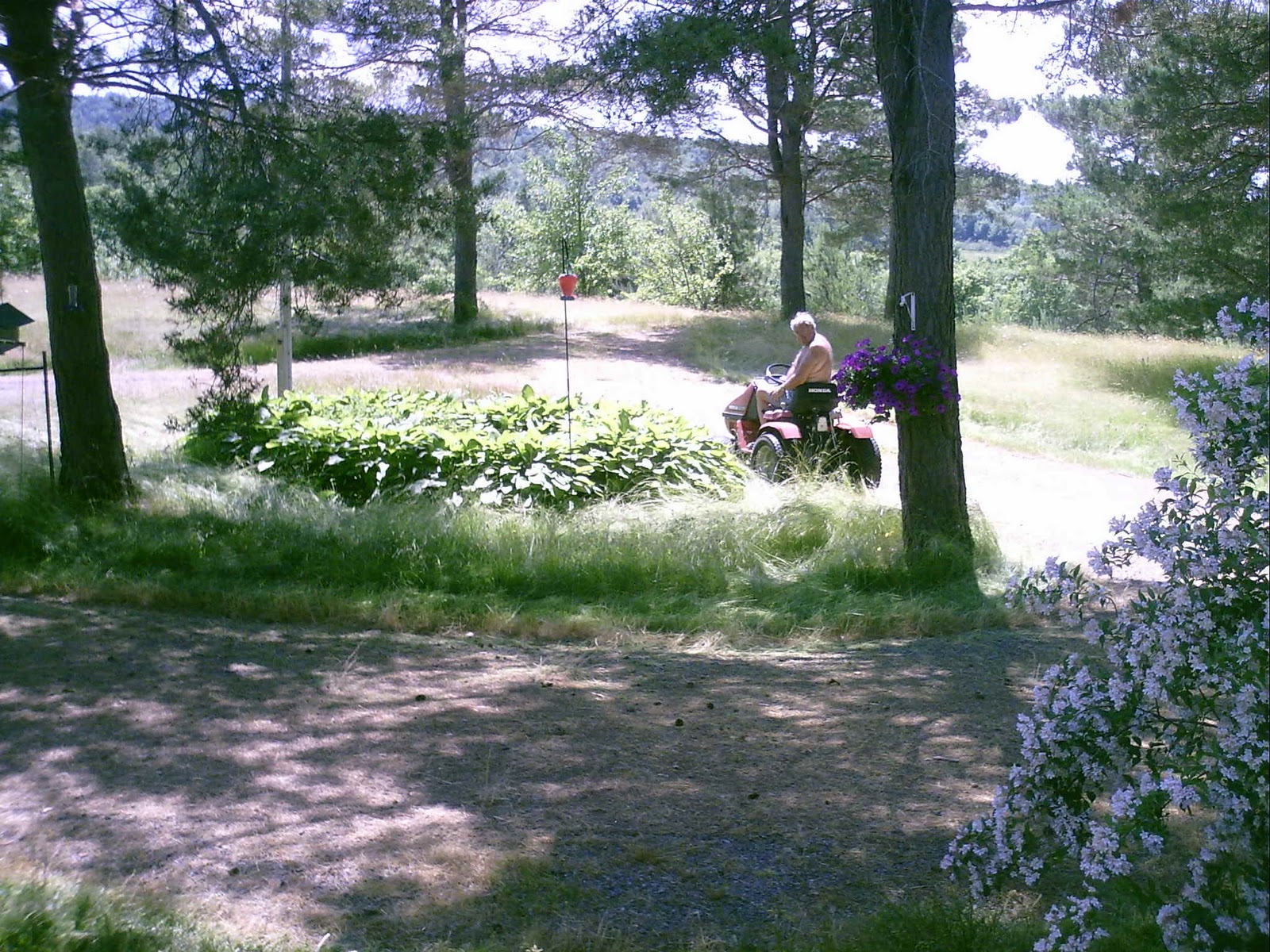
As our property is large, it means a lot of mowing--the easy way on a sit-on mower, but time-consuming nonetheless.  Hans at work.


We spend hot afternoons beside the pool, a wonderful part of our life here, the centre of many get-togethers with friends and family over the years.  My sister Paula and brother-in-law Laurie, who live just up the road, also have a pool and their seven grandchildren--all visiting from other parts of Canada--spent their days in the water.

Paula's grandchildren and relaxing days at their pool


Our pool below and Mary having a late-night swim


Summer also means special food and in the Atlantic provinces lobster and scallops, clams and mussels are offered everywhere.  You will not find better as they will be fresh from the sea.  Fish such as halibut and haddock are also on restaurant menus everywhere and sold in the supermarkets and fish wagons.

The cooked lobster below is showcased at the Halifax International Airport.  The sign next to them gives the prices.  The airport personnel will pack lobster and other shell fish to carry on board your flight home.


This summer I have eaten all of those crustaceans, mollusks and fish.  The Bay of Fundy is renowned for its lobster as well as for scallops and other seafood.  Digby is a small town about 40 minutes west of us famous for its scallops.  I have seen Digby scallops in supermarkets in Strasbourg, France--at a far greater price than we pay in Nova Scotia.  Lobster can be bought in Strasbourg as well but the cost is prohibitive.  As far as I am concerned, it is far superior when any shell fish is taken directly from the sea and on to the stove within a couple of hours.

The sign and the live lobsters were in Meteghan, a busy fishing town, on the French Shore of the Bay of Fundy.


Gertrud strolling along the boardwalk in Digby


Fishing boats at rest in Hampton, 20 minutes north of us on the Bay of Fundy.  The sign is on a retail fish store in Parker's Cove, along the Bay of Fundy.


Heiko and Heather treated us to a lobster dinner at home, picking up the lobster in Hampton, fresh out of the Bay of Fundy.  Heiko and our little granddaughter Natasha below.


The lighthouse and the fishing boats are in Hampton.


The Atlantic coast is also known for its seafood.  One of the special meals I enjoyed with two friends this summer was a lobster supper in Hubbards on the South Shore of the Atlantic Ocean, about two hours from us on the opposite sea coast.  Jean, Mary and I stayed at my sister Carol's house there.  We enjoyed a wonderful meal across the inlet at the Shore Club, which included not only a whole, freshly cooked lobster each, but all the mussels you could eat.


 My 1-1/4 lb lobster fresh from the pot


Mussels and lobsters!

Lobster bibs are used and when we have lobster at home, we wear them there as well.


Here is a recipe from my sister Paula.  It is delicious.

Paula's Fish Cakes
Saute 3 to 4 pieces of fresh or frozen (thawed) haddock, sole or other white fish until cooked through or simmer it gently in water until cooked through.  Drain and flake (break apart).  Peel and then boil 8 or 9 medium-size potatoes until tender; mash them well.  Saute some diced onion in butter so that it is a bit soft but not fully cooked.

Mix the flaked fish, mashed potatoes and onion together.  Add some butter, about a teaspoon of celery seed, McCormich's herb and garlic or, instead, a little Italian parsley, garlic powder to taste, salt and pepper.  (The salt and pepper are important for fish cakes.)  Mix everything really well and if need be add 1 to 2 tablespoons of cream to make combining it all easier.  The mixture will be fairly soft.  Then form the mixture into thick patties.  Cover them and place them in the refrigerator to rest and firm up.

When you are ready to cook the cakes, place fine breadcrumbs into a bowl with some salt and pepper and some McCormick's herb and garlic.  Gently beat two eggs in another dish.  Dip each fish pattie in the egg and then dip into the bread crumbs until all the patties have been covered with the crumbs.

Fry the fish cakes in lots of butter--the key to fine-tasting fish cakes--and fry on both sides.  You want them
nicely browned with a bit of crispness.  Serve with butter.  Salt and pepper to your own taste.

These fish cakes are superb as Paula made them this summer.  They were very soft inside and crisp on the outside.

Hans's Mussels

In 1/2 cup of olive oil, saute 4 large green onions, chopped, and 4 cloves of chopped garlic.  Add 1/2 bottle of dry white wine and the following herbs and spices:  lots of chopped parsley, 2 to 3 small tomatoes chopped, 3 to 4 slices red pepper, fresh basil, salt and pepper, a sprinkle of Fondor, a drop or two of Tabasco, basil and paprika.  Simmer 15 to 20 minutes.  Then bring it to a boil over high heat and add about 2 kilogram of mussels.  Add 1/2 cup water--or more.  Cook until the mussels open.  They are then ready to serve.  Just before the mussels are ready, add more parsley.  Hans cooked mussels this way in Spain one year.  They were superb. Both mussels and clams are steamed in a small amount of liquid, not boiled in a lot of water.  Note:  The wine used in this recipe would have mostly boiled off before the mussels were added.

Our time in Nova Scotia's Annapolis Valley is a time to renew friendships, to enjoy reminiscences, to see family and to gather together for food and drink.  It is also a time to relax and enjoy a totally different way of life from our life in Germany.

A rainbow at the end of a day at Hubbards


My next blog will be from Germany.  Enjoy the beautiful fall here in Nova Scotia everyone!